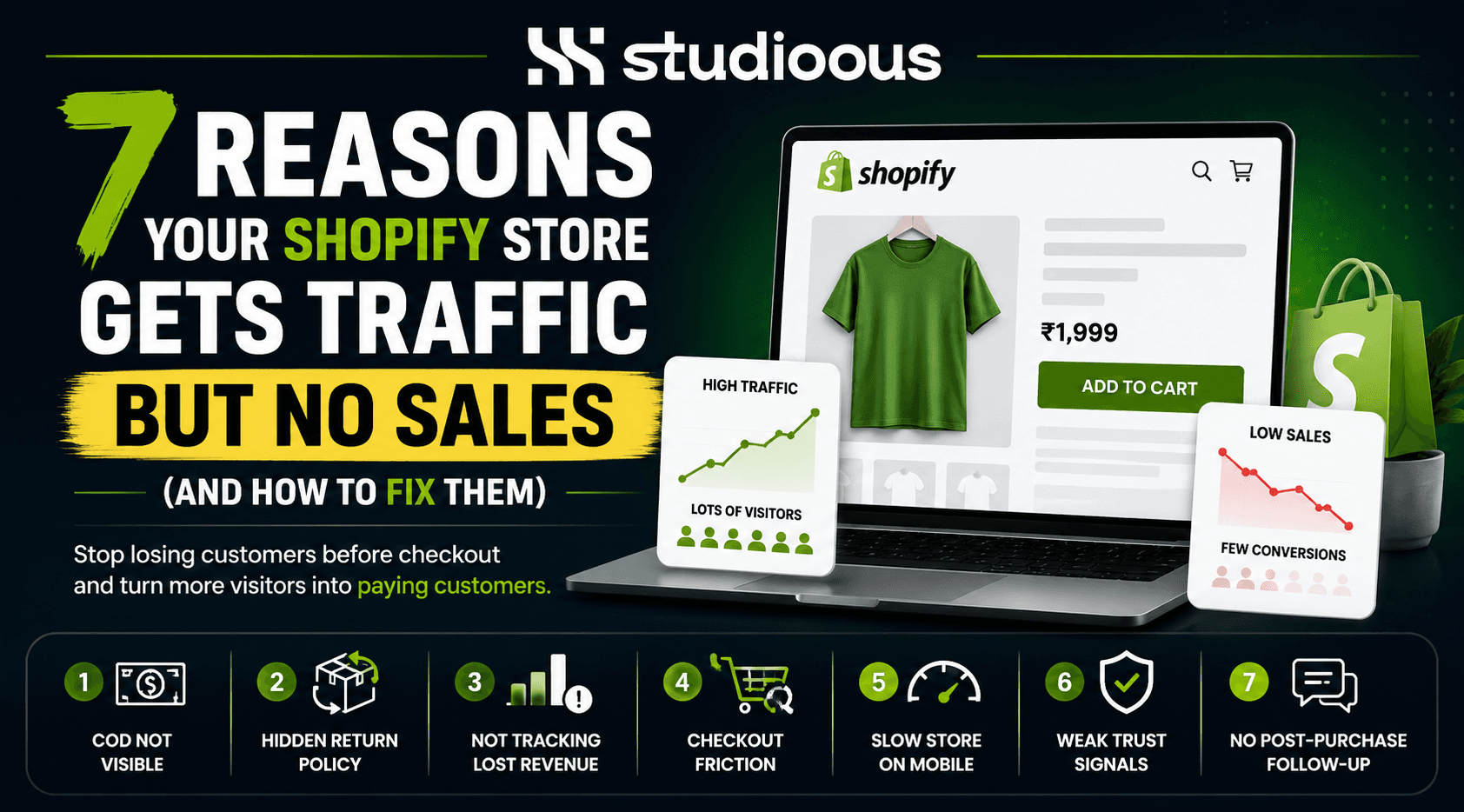
7 Reasons Your Shopify Store Gets Traffic but No Sales (And How to Fix Them)
Getting traffic but not enough sales? Learn how to fix the most common Shopify conversion issues and turn more visitors into paying customers.
SP
Subrata Porwal
July 10, 2026 · 8 min read
7 Signs Your Shopify Store Is Losing Sales Before Checkout (And How to Fix Them)
Your Shopify store is getting visitors.
Your Google and Meta Ads are bringing in traffic.
People are browsing your products.
But the sales aren't matching the effort or the money you're spending on marketing.
If this sounds familiar, you're not alone.
One of the biggest misconceptions in ecommerce is that more traffic automatically leads to more sales. In reality, many Shopify stores lose potential customers long before they reach the checkout page. It's rare because the product isn't good. More often, it's because small issues across your store create friction that makes shoppers leave.
From slow-loading pages and unclear return policies to missing trust signals and a complicated checkout experience, these seemingly minor issues can have a significant impact on your conversion rate.
The good news? Most of these problems are easy to identify and fix.
In this guide, we'll walk through seven common reasons Shopify stores lose sales before checkout and share practical ways to improve your store's performance, build customer trust, and increase conversions.
Whether you're launching a new D2C brand or looking to improve an existing Shopify store, these insights can help you turn more visitors into paying customers.
1. You're Not Highlighting Cash on Delivery (COD)
For Indian D2C brands, Cash on Delivery (COD) is more than just a payment option it's a trust signal.
Many shoppers, especially first-time buyers, prefer COD because it reduces the perceived risk of purchasing from a new brand. If customers can't quickly see that COD is available, they may leave your website before exploring your products further.
A common mistake is displaying COD only during the final checkout step. By then, many potential customers have already abandoned the purchase.
What You Should Do
Make COD visible from the moment customers land on your product page.
Simple additions like:
Cash on Delivery Available
Pay After Delivery
COD Available Across India
placed near the Add to Cart button can improve buyer confidence immediately.
Small trust indicators often have a bigger impact on conversions than expensive marketing campaigns.
2. Your Return Policy Is Difficult to Find
Before completing an online purchase, customers often ask themselves one question:
"What happens if I don't like the product?"
If the answer isn't easy to find, many won't take the risk.
A hidden return policy, confusing legal language, or unclear refund process creates hesitation especially for first-time buyers.
Customers don't expect every brand to offer free returns, but they do expect transparency.
What You Should Do
Instead of hiding your return policy in the website footer, highlight it where buying decisions happen.
For example:
Easy 7-Day Returns
Hassle-Free Exchanges
Simple Refund Process
Keep the language clear and straightforward.
The easier it is for customers to understand your policy, the more confident they'll feel about placing an order.
3. You're Tracking Orders but Not Measuring Lost Revenue
Many Shopify brands celebrate every new order.
Fewer businesses measure how many of those orders never turn into completed deliveries.
Cancelled Cash on Delivery orders and Return-to-Origin (RTO) shipments can quietly reduce profitability without appearing as obvious problems inside your Shopify dashboard.
High RTO rates often point to deeper issues such as:
Product pages creating unrealistic expectations
Poor audience targeting
Weak customer trust
Address validation issues
Lack of post-purchase communication
Ignoring these metrics means you're only looking at half the picture.
What You Should Do
Track more than just sales.
Monitor:
COD cancellation rate
Return-to-Origin (RTO) percentage
Conversion rate by traffic source
Customer acquisition cost (CAC)
Repeat purchase rate
You'll often discover that some campaigns generate plenty of orders but very little actual revenue.
4. Your Checkout Process Is Creating Unnecessary Friction
You've done the hard work.
A customer has discovered your product, explored your website, and decided to make a purchase.
The last thing you want is a complicated checkout process that gives them a reason to leave.
Every additional step, form field, or distraction increases the chances of cart abandonment.
For mobile shoppers, the impact is even greater. Most D2C purchases in India happen on smartphones, where customers expect a fast and hassle-free checkout experience.
Some of the most common issues include:
Too many mandatory form fields
No guest checkout option
Slow-loading checkout pages
Limited payment methods
Unclear delivery timelines
These small inconveniences quickly add up, causing customers to abandon their carts before completing the purchase.
What You Should Do
Review your checkout experience from a customer's perspective.
Ask yourself:
Can someone complete a purchase in under two minutes?
Is guest checkout clearly available?
Are payment options easy to understand?
Is the checkout optimized for mobile users?
A shorter, faster checkout process can significantly improve your Shopify conversion rate without increasing your advertising budget.
5. Your Store Loads Too Slowly on Mobile
Speed isn't just a technical metric it's directly tied to sales.
If your Shopify store takes more than a few seconds to load, many visitors won't wait around. They'll simply leave and continue shopping elsewhere.
This becomes even more important for Indian ecommerce brands, where most users browse on mobile devices with varying internet speeds.
Common reasons for slow Shopify stores include:
Large, uncompressed images
Heavy Shopify themes
Too many third-party apps
Multiple tracking scripts
Unoptimized videos and animations
Even a one-second improvement in page load time can positively impact engagement and conversions.
What You Should Do
Regularly test your website's performance using tools like Google PageSpeed Insights.
Focus on:
Compressing images
Removing unused apps
Delaying non-essential scripts
Optimizing your theme
Improving Core Web Vitals
At Studioous, page speed optimization is often one of the first recommendations during Shopify performance audits because faster stores don't just rank better they convert better.
6. Your Product Pages Leave Customers With Questions
Your product page should answer every important question before a customer has to ask it.
If shoppers need to search elsewhere for basic information, you're creating unnecessary friction in the buying journey.
Many Shopify stores focus heavily on attractive visuals but overlook the practical information customers need before making a purchase.
Questions like:
What material is this made of?
What are the exact dimensions?
Is this suitable for daily use?
How long will delivery take?
Is this product covered under warranty?
If these answers aren't easy to find, customers hesitate and hesitation often leads to lost sales.
What You Should Do
Audit your highest-selling product pages.
Make sure each page includes:
Detailed product descriptions
Size and specification information
Delivery estimates
Return policy summary
Frequently Asked Questions
Genuine customer reviews
High-quality product images
The goal isn't to add more content.
It's to give customers the confidence they need to complete their purchase.
7. You're Losing Visitors Because You Have No Follow-Up Strategy
Not every visitor buys during their first visit.
In fact, most don't.
The mistake many Shopify brands make is assuming those visitors are gone forever.
They're not.
Without a follow-up strategy, you're relying entirely on paid retargeting ads to bring them back, a strategy that becomes increasingly expensive over time.
Instead, successful D2C brands build multiple touchpoints that keep potential customers engaged until they're ready to buy.
These include:
WhatsApp opt-ins
Email capture forms
Browse abandonment reminders
Cart recovery emails
Exclusive offers for first-time customers
These channels allow you to reconnect with interested shoppers without paying repeatedly for the same traffic.
What You Should Do
Create simple, value-driven follow-up journeys.
Instead of sending generic promotional messages, focus on helping customers make a buying decision.
For example:
Answer common product questions.
Share customer reviews.
Highlight your return policy.
Notify customers when products are back in stock.
Offer relevant recommendations based on browsing behaviour.
Building trust over time often leads to better conversions than pushing immediate discounts.
Every Small Improvement Adds Up
Most Shopify stores don't lose sales because of one major problem.
They lose sales because of several small issues working together.
A slow-loading website.
An unclear return policy.
A complicated checkout.
Missing trust signals.
Weak product pages.
No customer follow-up.
Individually, these issues might seem minor.
Together, they can significantly reduce your conversion rate and increase your customer acquisition cost.
The good news is that none of these problems require a complete website rebuild.
Most can be fixed through targeted improvements that make the shopping experience smoother, faster, and more trustworthy.
That's where regular Shopify audits become valuable; they help identify what's stopping customers from completing their purchase before those issues impact your growth.
Why Your Shopify Store Needs More Than Just Traffic
Getting visitors to your store is only the first step.
The real challenge is converting those visitors into paying customers and that's where many D2C brands struggle.
A well-optimized Shopify store isn't just visually appealing. It should guide customers smoothly from product discovery to purchase, removing friction at every stage of the buying journey.
This requires more than running ads or changing a few design elements. It takes a clear understanding of customer behaviour, data, and continuous optimization.
At Studioous, we work with D2C brands to identify what's slowing growth and implement improvements that drive measurable results. From Shopify development and conversion rate optimization (CRO) to performance marketing and user experience improvements, every recommendation is backed by data and focused on helping businesses sell more—not just attract more traffic.
Whether it's reducing cart abandonment, improving mobile performance, optimizing landing pages, or creating high-converting customer journeys, our goal is simple: help your Shopify store perform at its full potential.
Frequently Asked Questions
Why is my Shopify store getting traffic but not sales?
Traffic alone doesn't guarantee conversions. Slow page speed, poor product pages, lack of trust signals, complicated checkout processes, and unclear return policies are some of the most common reasons visitors leave without making a purchase.
What is a good Shopify conversion rate?
The average Shopify conversion rate typically ranges between 2% and 3%, although it varies by industry. Stores consistently achieving 3% or higher usually have well-optimized product pages, faster loading times, and a streamlined checkout experience.
How can I improve my Shopify conversion rate?
Improving your Shopify conversion rate starts with understanding where customers are dropping off. Focus on improving page speed, simplifying checkout, building trust with reviews and clear policies, optimizing product pages, and continuously testing your store's user experience.
Does page speed really affect Shopify sales?
Yes. A slow-loading website increases bounce rates and reduces conversions. Improving your site's performance not only creates a better customer experience but also supports SEO and can improve your visibility in search results.
Should every Shopify store offer Cash on Delivery (COD)?
For many D2C brands in India, offering COD can improve customer trust and encourage first-time purchases. Displaying COD availability prominently on product pages helps customers make faster buying decisions.
When should I consider a Shopify store audit?
If your store receives consistent traffic but struggles with conversions, high cart abandonment, or declining sales, a Shopify store audit can help identify the issues affecting performance and prioritize improvements.
Final Thoughts
Growing a successful Shopify store isn't about chasing every new trend or increasing your advertising budget every month.
It's about creating a shopping experience that makes customers feel confident enough to complete their purchase.
Often, the biggest improvements come from fixing the small things—speeding up your website, simplifying your checkout, answering customer questions before they're asked, and building trust at every stage of the buying journey.
These changes may seem incremental, but together they can have a significant impact on conversion rates, customer satisfaction, and long-term revenue.
If your Shopify store is attracting visitors but not generating the sales you expect, it's worth taking a closer look at what's happening before checkout.
Ready to Improve Your Shopify Store's Conversion Rate?
Every Shopify store has opportunities to convert more visitors into customers. The challenge is knowing where to start.
A Shopify Store Audit from Studioous helps uncover the issues that are affecting your store's performance from slow-loading pages and checkout friction to product page optimization and customer trust signals.
Instead of guesswork, you'll receive clear, actionable recommendations that help improve user experience, increase conversions, and maximize the return on your marketing investment.
Want to know what's holding your Shopify store back? Get in touch with Studioous and discover how small improvements can lead to measurable business growth.



Comments