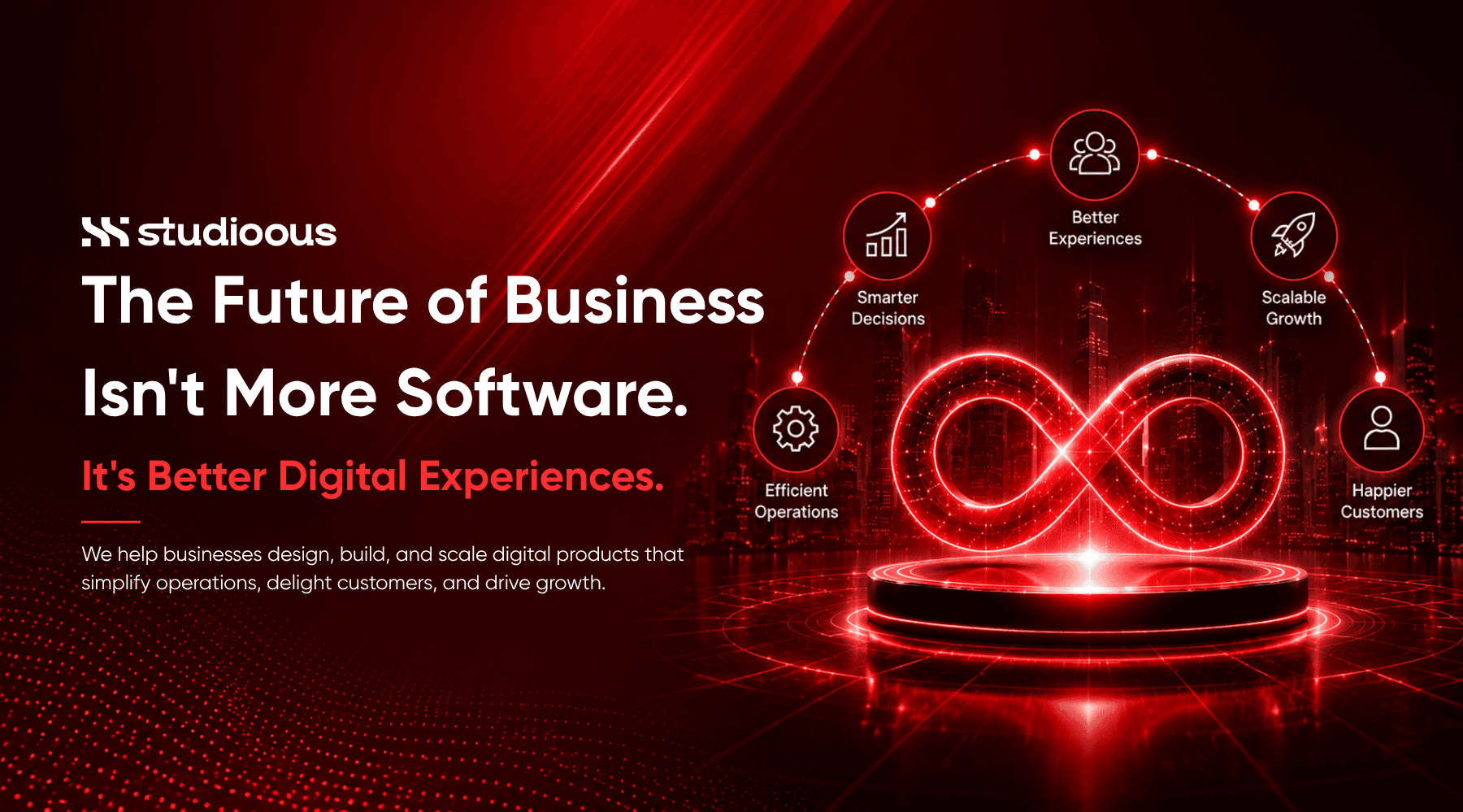
Businesses don't need more tools, they need better systems. Explore how digital product development, AI, and automation create scalable digital experiences.
Businesses today have access to thousands of software solutions.
From CRM platforms and project management tools to AI applications and automation software, technology has become more accessible than ever. Yet many organizations continue to face the same challenges they were trying to solve in the first place.
Teams work across disconnected systems. Manual processes slow down operations. Customer experiences remain inconsistent. Data is scattered across multiple platforms, making decision-making difficult.
This raises an important question:
If businesses have more technology than ever before, why are they still struggling with efficiency and growth?
The Problem Isn't Technology. It's Fragmentation.
Many businesses adopt software reactively.
A new customer management tool is added to improve sales processes. A separate reporting platform is introduced for analytics. Operations are managed through another system, while communication happens somewhere else entirely.
Individually, these tools may work well. Collectively, they often create disconnected workflows that increase complexity instead of reducing it.
As businesses grow, so does their technology stack. What starts as a solution eventually becomes a challenge of its own.
The result is:
Duplicate data across systems
Manual data transfers between departments
Limited visibility into business performance
Higher operational costs
Slower decision-making
This is one of the primary reasons many digital transformation initiatives fail to deliver expected results.

Why Digital Experience Matters More Than Software
Successful businesses are no longer focused on adding more software.
They are focused on creating better digital experiences.
A digital experience is the way customers, employees, and stakeholders interact with technology throughout their journey with a business.
Whether it's a customer portal, mobile application, SaaS platform, internal workflow system, or AI-powered solution, the goal remains the same:
Make processes simpler, faster, and more efficient.
When technology is designed around user needs and business objectives, it delivers measurable value instead of adding complexity.
What Makes a Great Digital Experience?
A successful digital product does more than perform a function. It helps businesses operate smarter.
The most effective digital solutions typically share these characteristics:
Connected Workflows
Information flows seamlessly between departments, systems, and users without manual intervention.
User-Centric Design
Technology should be easy to use, intuitive, and built around real user behavior.
Automation Where It Matters
Repetitive and time-consuming tasks are automated, allowing teams to focus on higher-value work.
Scalability
The solution should support business growth without requiring constant redevelopment or replacement.
Actionable Insights
Data should be accessible, organized, and useful for making informed business decisions.
The Growing Role of AI and Automation
Artificial Intelligence and automation are transforming how businesses operate.
However, implementing AI without a clear business objective often leads to disappointing outcomes.
The organizations seeing real success with AI are using it to solve specific challenges such as:
Customer support automation
Workflow optimization
Predictive analytics
Data processing
Operational efficiency improvements
The value comes not from using AI itself, but from applying it strategically within a broader digital ecosystem.
Why Businesses Are Investing in Product Engineering
Traditional software development focuses on building applications.
Product engineering focuses on solving business problems.
This approach combines business strategy, user experience, software architecture, automation, and scalability planning to create digital products that generate long-term value.
Instead of building standalone applications, product engineering helps businesses create systems that support growth, efficiency, and innovation.
Building Technology With Purpose
The future belongs to businesses that use technology strategically.
The companies that succeed won't necessarily be those with the largest software budgets or the most tools.
They will be the organizations that build connected systems, improve digital experiences, automate intelligently, and align technology with business goals.
At Studioous, we help businesses design, develop, and scale digital products that solve real-world challenges through product engineering, web and mobile development, SaaS solutions, AI integrations, automation, and user-focused digital experiences.
Because the future isn't about building more software.
It's about building technology that actually works for your business.